
Table of Contents
ToggleContent Marketing: A Complete Guide for Beginners and Businesses

In the digital age, businesses are no longer relying only on advertisements to reach their audience. Instead, they focus on providing valuable information that attracts, engages, and builds trust with potential customers. This strategy is known as CONTENT MARKETING . It has become one of the most effective digital marketing techniques for building brand awareness, generating leads, and improving customer relationships.
What is Content Marketing?
Content marketing is a strategic marketing approach that focuses on creating and distributing valuable, relevant, and consistent content to attract and retain a clearly defined audience.
Unlike traditional advertising that directly promotes products, content marketing provides useful information that helps customers solve problems or learn something new.
Importance of Content Marketing
Content marketing plays a crucial role in modern digital marketing strategies. It helps businesses connect with audiences in a meaningful way.
1. Builds Brand Awareness:
High-quality content introduces your brand to new audiences. When users find helpful articles, videos, or social posts, they begin to recognize and remember your brand.
2. Improves Search Engine Rankings:
Search engines like Google rank websites higher when they publish valuable and relevant content regularly. SEO-optimized content helps businesses appear in search results and attract organic traffic.
3. Builds Trust and Authority:
Informative content shows expertise in a particular field. When businesses consistently provide useful information, audiences begin to trust them as industry experts.
4. Generates Leads and Conversions:
Content marketing guides potential customers through different stages of the buying journey, eventually encouraging them to take action such as subscribing, contacting, or purchasing.
5. Supports Other Marketing Channels:
Content is the foundation for many digital marketing strategies including social media marketing, email marketing, and search engine optimization.
Types of Content Marketing
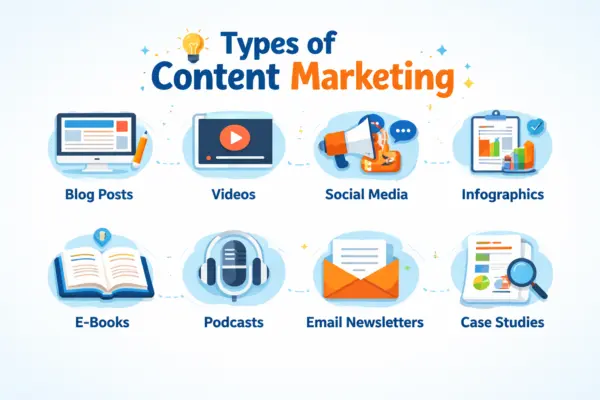
1.Blog Posts
Blogs are one of the most popular forms of content marketing. They help answer user questions, improve SEO rankings, and provide detailed information about topics related to your business.
2.Videos
Video content is highly engaging and easily shareable. Businesses often use videos for tutorials, product demonstrations, and storytelling.
3.Social Media Content
Platforms like Instagram, Facebook, and LinkedIn allow brands to share engaging content such as images, short videos, and updates.
4.Infographics
Infographics visually present complex information in a simple and attractive format, making it easier for audiences to understand data and statistics.
5.E-books and Guides
These are long-form content pieces that provide detailed knowledge on specific topics. They are often used for lead generation.
6.Podcasts
Podcasts allow businesses to share insights, interviews, and discussions with audiences who prefer audio content.
7.Email Newsletters
Email newsletters are used to share updates, valuable content, and promotions directly with subscribers to maintain engagement and build strong relationships with the audience.
8.Case Studies
Case studies present real-life examples of how a product or service solved a problem, helping build trust and demonstrate the effectiveness of a business.
Content Marketing Strategy
A successful content marketing campaign requires a well-planned strategy.
- Identify Your Target Audience:
Understanding your audience is the first step. Businesses should analyze demographics, interests, and problems faced by their potential customers.
- Set Clear Goals
Content marketing goals may include:
Increasing website traffic
Generating leads
Building brand awareness
Improving customer engagement
- Perform Keyword Research
Keyword research helps identify what people are searching for online. Tools such as Google Keyword Planner, SEMrush, and Ahrefs can help discover relevant keywords.
- Create High-Quality Content
Content should be informative, engaging, and valuable to the audience. It should solve problems or answer questions.
- Distribute Content
Publishing content alone is not enough. It should be promoted through social media, email marketing, and SEO strategies.
- Measure Performance
Content performance can be analyzed using tools like Google Analytics to track traffic, engagement, and conversions.
Benefits of Content Marketing for Businesses
Content marketing provides long-term benefits for businesses.
Cost-effective marketing strategy
Higher customer engagement
Increased website traffic
Improved brand loyalty
Better SEO performance
Long-term digital presence
Unlike paid advertisements that stop generating results when the campaign ends, quality content continues to attract audiences for months or even years.
Challenges in Content Marketing
Although content marketing offers many advantages, it also comes with challenges.
Creating consistent and high-quality content
Standing out in a competitive digital environment
Measuring return on investment (ROI)
Understanding audience preferences
Businesses need a clear strategy and continuous effort to overcome these challenges.
Comparison Between SEO, Content Marketing, and Email Marketing
Email marketing vs Contnt marketing vs SEO
| Aspect | Email Marketing | Content Marketing | SEO (Search Engine Optimization) |
|---|---|---|---|
| Definition | Sending emails to promote products or communicate with customers. | Creating and sharing valuable content to attract an audience. | Optimizing websites to rank higher on search engines. |
| Goal | Increase conversions and customer engagement. | Build trust and educate the audience. | Increase website visibility and organic traffic. |
| Content Type | Newsletters, promotional emails, updates. | Blogs, videos, infographics, articles. | Optimized web pages, blogs, keywords. |
| Audience | People who subscribed to emails. | Wider audience through websites and social media. | People searching on search engines. |
| Metrics | Open rate, click rate, conversions. | Traffic, engagement, shares. | Rankings, organic traffic, backlinks. |
Content marketing is an essential part of modern digital marketing strategies. By creating valuable and relevant content, businesses can attract potential customers, build trust, and establish long-term relationships with their audience.
Instead of directly selling products, content marketing focuses on educating, engaging, and providing value, which ultimately leads to stronger brand loyalty and sustainable business growth.